Lead Generation for Contractors: Profit per Job, Not Cost per Lead (2026)
By Sebastian Hardy, Founder of MYA (Market Your Architecture) · October 2026
Most contractors are not short on leads.
They are short on money from the leads they already paid for.
This year we looked inside 14 residential construction ad accounts. Design-build firms, remodelers, kitchen and bath companies, luxury custom builders.
$229,439 in ad spend. 1,746 leads.
In four of the accounts we audited in detail, more than 70% of the paid leads were never worked.
Nobody called them.
Two companies got exactly 43 leads each.
One paid $178 per appointment. The other paid $1,344.
Same number of leads. Seven and a half times the cost.
And not one of the six companies we audited could tell you which of their ad leads actually made them money.
That is the real problem with lead generation for contractors in 2026, and it has very little to do with the ads.
It's the math after the lead.
A $40 lead that never picks up the phone is expensive.
A $400 lead that turns into a $250,000 addition is the cheapest thing you will buy all year.
I'm Sebastian Hardy. My company, MYA, runs ads and sales systems for design-build firms, remodelers and custom builders across the US. Every client below is anonymized. Every number is real.
Below: what leads cost at every project size, from $5,000 bathrooms to $5 million homes. Which channel fits which job. Why booked homeowners don't show up. And the one number almost nobody tracks, even though it decides whether any of the money was worth spending.
Key takeaways
- On $5,000 to $50,000 jobs, leads should cost $15 to $50, quality conversations $100 to $300, and you should close 10% to 30%. Whichever number misses tells you what to fix.
- Luxury builders pay about 3x more per lead. Fine. One $5 million home pays for years of ads.
- Google captures demand. Meta creates it. Pick by project size.
- Most paid leads die in the CRM, not in the ad account.
- No-shows happen because the homeowner doesn't understand the logistics or doesn't trust you yet.
- Set your budget from gross profit per job, never from cost per lead.
About the data in this article
Everything here comes from MYA's own review of the residential contractor accounts we manage, pulled in October 2026:
- 14 residential construction Meta ad accounts: luxury custom builders, design-build firms, remodelers, kitchen and bath companies, home additions and home builders. Together they spent $229,439 on Meta and generated 1,746 leads between January 2025 and October 21, 2026, including $106,936 and 986 leads in 2026 alone.
- Six monthly client reports (June to September 2026) that join Meta results to each client's CRM: bookings, stages, untouched leads and closed projects.
- Ads Manager screenshots from four of those accounts (Contractors A to D), captured October 22, 2026 and cropped to remove anything identifying. No figures were altered.
- Search demand data for 90 contractor marketing keywords and live Google results for 14 of them, pulled October 22, 2026.
All clients are anonymized. Lead and appointment counts are as reported by Meta unless the text says they come from the CRM.
{{banner-large-cp="/banners"}}
What does a contractor lead really cost in 2026?
Cost per lead is the number that is lying to you.
It's the least useful number in your marketing report, and every platform shows it to you first. A lead is a name and a phone number. What you're actually buying is a signed contract with enough margin left after the job to make it worth doing.
The five numbers that decide whether your marketing works
Every lead moves through five stages, and each one has its own cost.
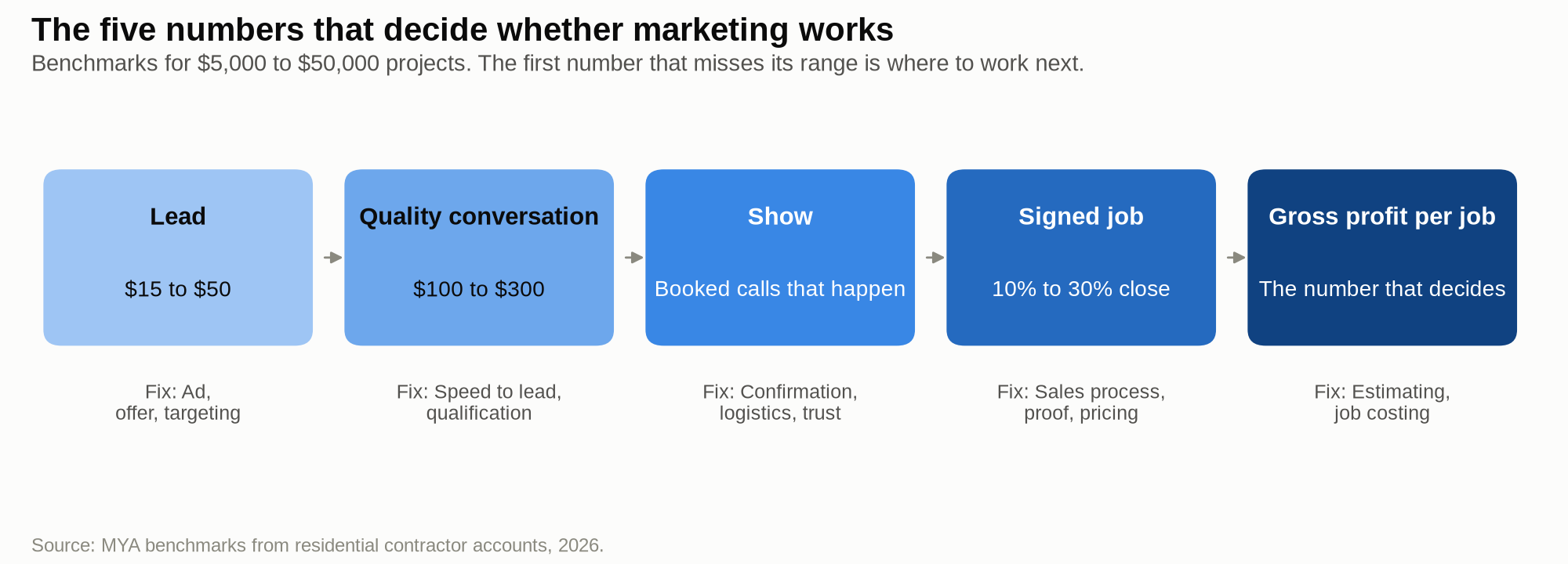
- Cost per lead (CPL). What you pay for a form fill or a call. This measures your ad, your offer and your targeting.
- Cost per quality conversation. What you pay for a real conversation with a homeowner who fits your projects, budget and service area. This measures lead quality and how fast you respond.
- Show rate. The share of booked consultations where the homeowner actually turns up. This measures your confirmation process and how much trust you built before the call.
- Close rate. The share of quality conversations that sign. This measures your sales process, your pricing and your proof.
- Gross profit per job. What is left after labor, materials, subs and equipment are paid. This is the number that decides whether every number above it was good or bad.
Most contractors track the first one, guess at the fourth and never connect the fifth back to the lead source. That is how a company ends up cutting the campaign that was quietly producing its most profitable work.
What we see by project size
These are the ranges I give every new client. The higher the tier, the wider the range: fewer projects, slower decisions, smaller audiences.
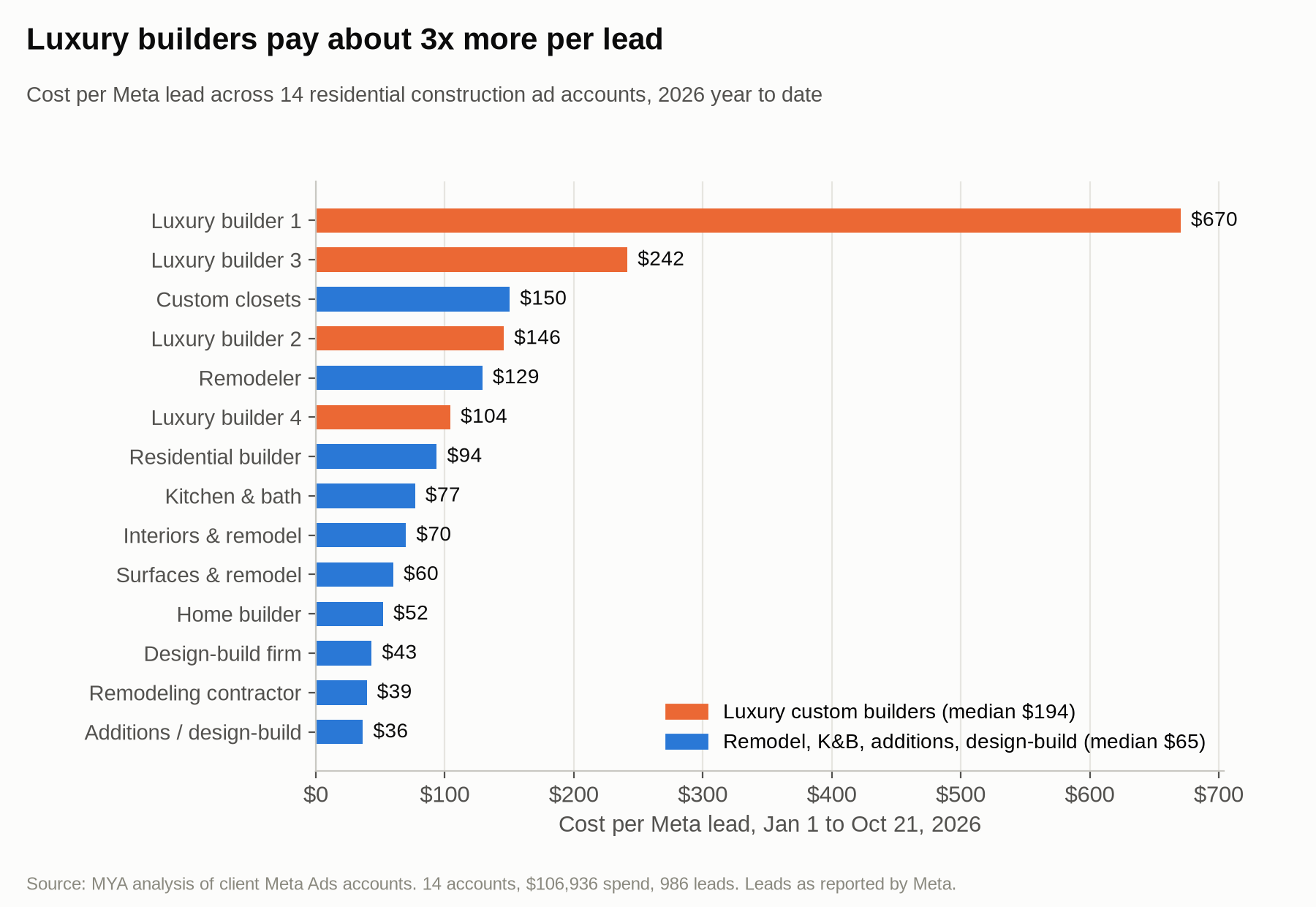
The middle rows come straight from 2026 client data. On Meta, a Miami firm doing home additions and design-build work (projects from about $20,000 into the millions) generated 173 leads at a blended $37.31 between launch and June 29, 2026, with about $202 per booked appointment. A kitchen and bath company paid $66.53 per lead and $226 per booked call in its first month, September 2026. A Miami residential builder paid $96 per lead, with every lead verifying its phone number before the form submitted. At the top end, our four luxury custom-builder accounts paid between $104 and $670 per lead in 2026, a median of $194. The ten remodel, kitchen and bath, additions and design-build accounts paid a median of $65. Roughly three times more. That's what you should expect. Very few families can build a multi-million dollar home, and each one is worth far more.
For outside context, WordStream's 2026 benchmarks put the average cost per lead for "Home and Home Improvement" at $42.95 on Facebook lead campaigns (published September 15, 2026, up 4.1% while most industries got cheaper) and $90.92 on Google Ads, with an average cost per click of $8.33 on Google, the second most expensive of 23 industries they track.
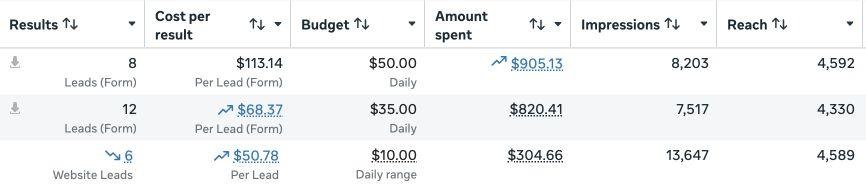
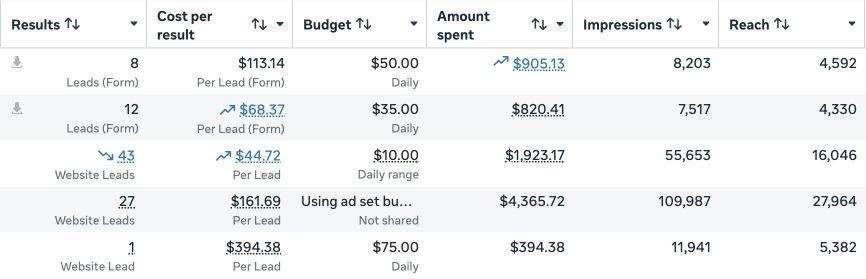
Project type moves cost per lead as much as the platform does. In one account (Contractor A in the screenshots below), the last 30 days through October 21, 2026 showed an ADU campaign reporting 12 form leads at $68.37 each, while a kitchen and bath campaign in the same account reported 8 at $113.14. Over the full year to date, the same company's website lead campaigns ranged from $44.72 to $161.69 per reported lead.
Same 43 leads, a 7.5x difference in appointment cost
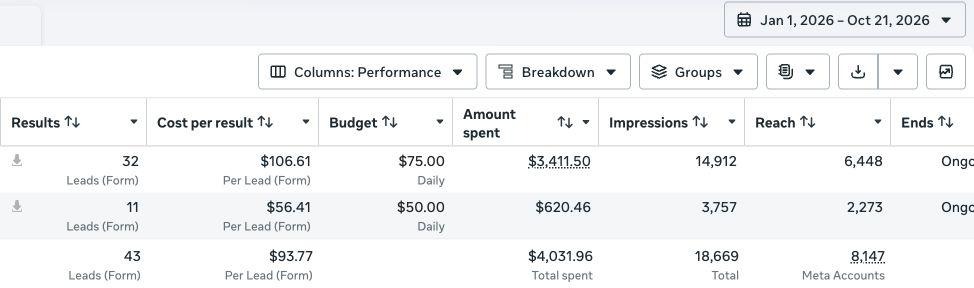
Two of our contractor accounts each reported exactly 43 Meta form leads between January 1 and October 21, 2026.
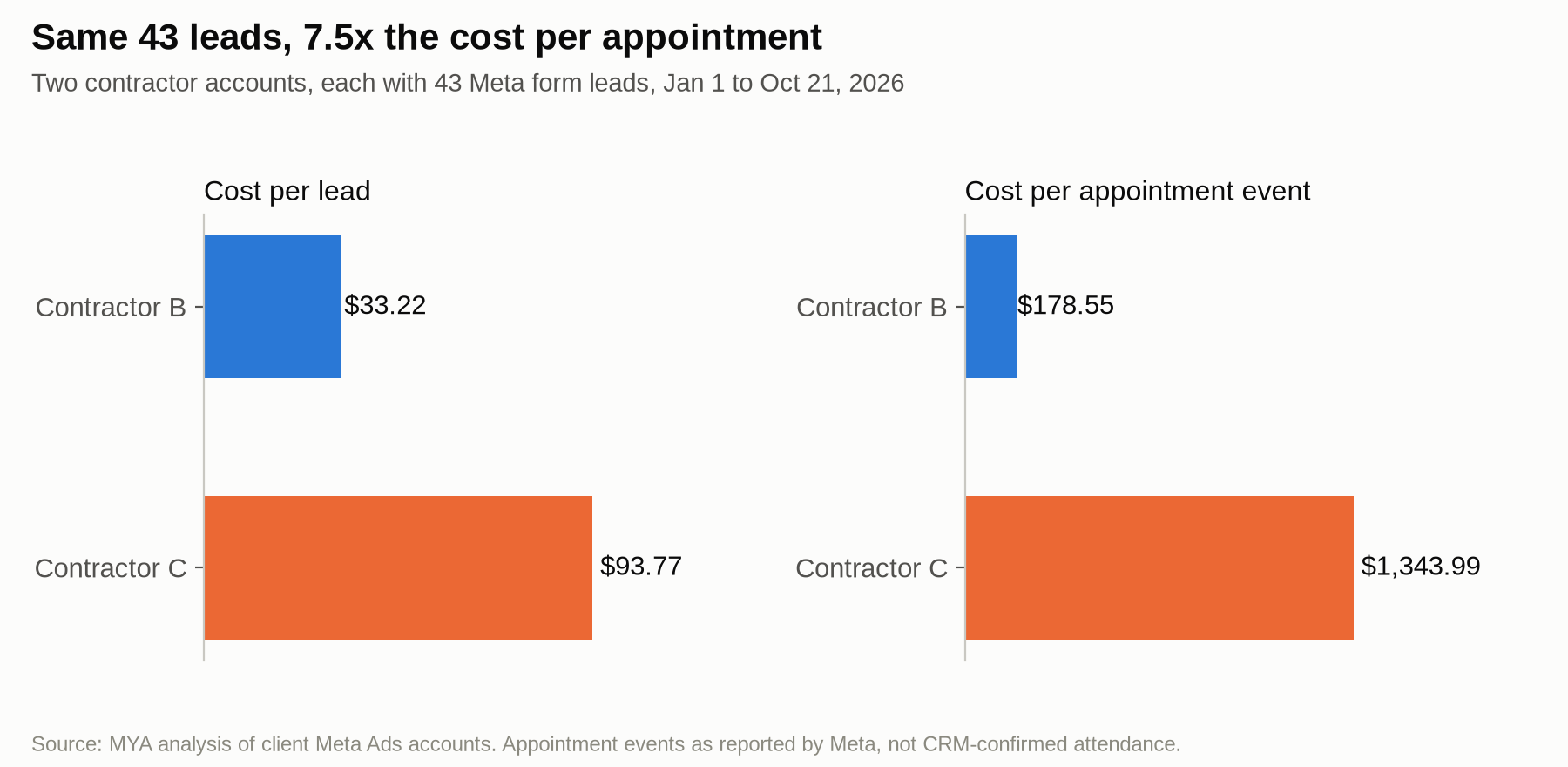
Contractor C paid less than three times more per lead, and 7.5 times more per appointment.
Two caveats. These are appointment events from Meta's tracking, not attended appointments from the CRM. And these are different companies in different markets, so treat it as an illustration. Look only at leads and the two accounts are identical. They aren't. Neither number is profit yet, either. For that you need the CRM and the job cost.



Check what the platform is counting as a "result"
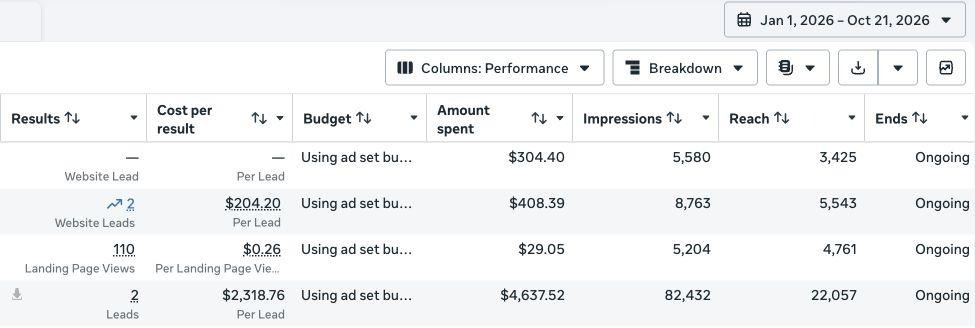
The cheapest number in an ads report is often not a lead at all. In Contractor D's account, one campaign reported 110 results at $0.26 each. Those results were landing page views. Separate campaigns in the same account reported 2 website leads at $204.20 each and 2 results labeled "Leads" at $2,318.76 each. Skim the "cost per result" column without reading the label underneath and you'll think something is working when it isn't.
Meta also changed how it counts this year. Meta now shows advertisers a notice that, starting March 17, 2026, click results report website conversions only after link clicks, while engagement results report conversions after other ad actions. Compare 2026 with 2025 inside Meta and some of the difference is the counting. Your CRM doesn't have that problem.

Which number is broken? Marketing or sales
Find the first number that misses its range. That's where your next dollar goes.
Marketing articles skip the last row. You can do everything right up front and still lose money, because the job you won was priced off the wrong labor rate.
Why is cost per lead the wrong number to manage?
Because platforms are very good at selling you cheap leads. Tell Meta or a lead marketplace you want the lowest cost per lead and they'll find the people most likely to fill in a form. Those are rarely the people who sign a $250,000 contract.
The maximum acquisition cost formula
When I set a budget with a contractor, I start from the job, not the ad.
Maximum cost per signed job = gross profit per job × the share of gross profit you are willing to spend to win it
Maximum cost per quality conversation = maximum cost per signed job × your close rate
Maximum cost per lead = maximum cost per quality conversation × the share of leads that become quality conversations
Every input in that formula comes from your own books. Gross profit per job should come from actual job costs, not the estimate. If your labor numbers are off, for example because the burdened labor rate in your estimate is wrong, everything downstream is off too.
Worked example 1: a $30,000 bathroom
- Contract value: $30,000. Say your actual gross margin on baths is 35%, so gross profit is $10,500.
- You decide you will spend up to 12% of gross profit to win a job: $1,260 per signed job.
- You close 20% of quality conversations: you can afford $252 per conversation.
- One in four leads becomes a quality conversation: you can afford about $63 per lead.
Those numbers line up with the benchmarks in the table above. A contractor paying $45 per lead and $180 per conversation on baths is in good shape. A contractor paying $45 per lead but only reaching one lead in ten has a conversation cost of $450, and that is a follow-up problem, not an ad problem.
Worked example 2: a $250,000 addition
- Contract value: $250,000 at a 25% gross margin: $62,500 gross profit.
- Spend up to 10% of that to win it: $6,250 per signed job.
- Close 20% of quality conversations: $1,250 per conversation is affordable.
Now look at the real 2026 numbers again: $202 to $777 per booked call across our residential accounts. Even the most expensive of those is comfortably inside what an addition can carry. When the owner of a firm like that tells me "the leads are too expensive", what they usually mean is "I have not closed one yet", which is a different problem.
Worked example 3: the $5 million home
This is where most contractors talk themselves out of growth.
Say you build luxury custom homes. You run a campaign at $10,000 a month and it brings in five very high-quality leads a month. Most months, nobody signs. Then one of those families decides to build a $5 million home with you, and at a 20% margin that is roughly $1 million in gross profit.
Even if it takes six months, you spent $60,000 to make $1 million. I've never met a builder who would say no to that trade if you offered it straight. In practice they say no anyway: they look at month two, see $2,000 per lead, and switch it off.
You spent $60,000 to make $1 million. Nobody turns that down. They just switch the campaign off in month two.
At this level, judge the campaign on pipeline value over six to twelve months. A small audience means expensive leads. The only question is whether the right families are coming in.
The number none of our clients were tracking
When we reviewed six client reports covering June to September 2026, every one had the same gap: project values were not entered against that period's ad leads in the CRM. In one account, monetary value was $0 on all 152 opportunities since launch.
So none of them could answer the question that matters: which lead source made the most gross profit? They knew their cost per lead and cost per booked call. They had no idea what the ads returned.
The fix is simple and boring:
- Enter an estimated project value when a proposal goes out, even if it is a range.
- Enter the signed contract value when the job closes.
- Pull actual gross profit from your job-costing system when the job is done, and tie it back to the original lead source.
Step three is where most companies break, because labor cost lives in payroll, hours live in a time app, and the job lives in project management software like JobTread or Buildertrend. Until those connect, "profit per job by lead source" is a guess. Posting actual payroll cost to each job is the problem Dapt's job costing software solves. Once that's in place, your marketing report can list profitable jobs instead of leads.
How are homeowners finding contractors in 2026?
Two things changed: spending went flat, and search moved to AI.
The market: flat spending, steady remodeling sentiment
- Harvard's Joint Center for Housing Studies released its Leading Indicator of Remodeling Activity on October 22, 2026. It projects remodeling spending to stay "relatively flat through late 2027", with growth of just 1.5% by the third quarter of 2027 and annual spending of around $525 billion.
- The NAHB/Westlake Royal Remodeling Market Index came in at 62 for the third quarter of 2026 (published October 8, 2026). The leads and inquiries component sat at 53, and large remodeling projects scored 66. NAHB's chief economist said remodeling is "gaining share in the overall construction market."
- New construction is weaker. NAHB's builder confidence index fell to 29 in October 2026, the lowest since June 2012, and a record 43% of builders cut prices. Freddie Mac's 30-year fixed rate was 7.40% on October 15, 2026.
Homeowners locked into low mortgage rates are fixing up the house they have instead of moving. That keeps remodeling and design-build demand steady while new home sales struggle. But demand isn't growing on its own. Any growth you get, you take from a competitor.
The search shift: fewer clicks, more AI answers
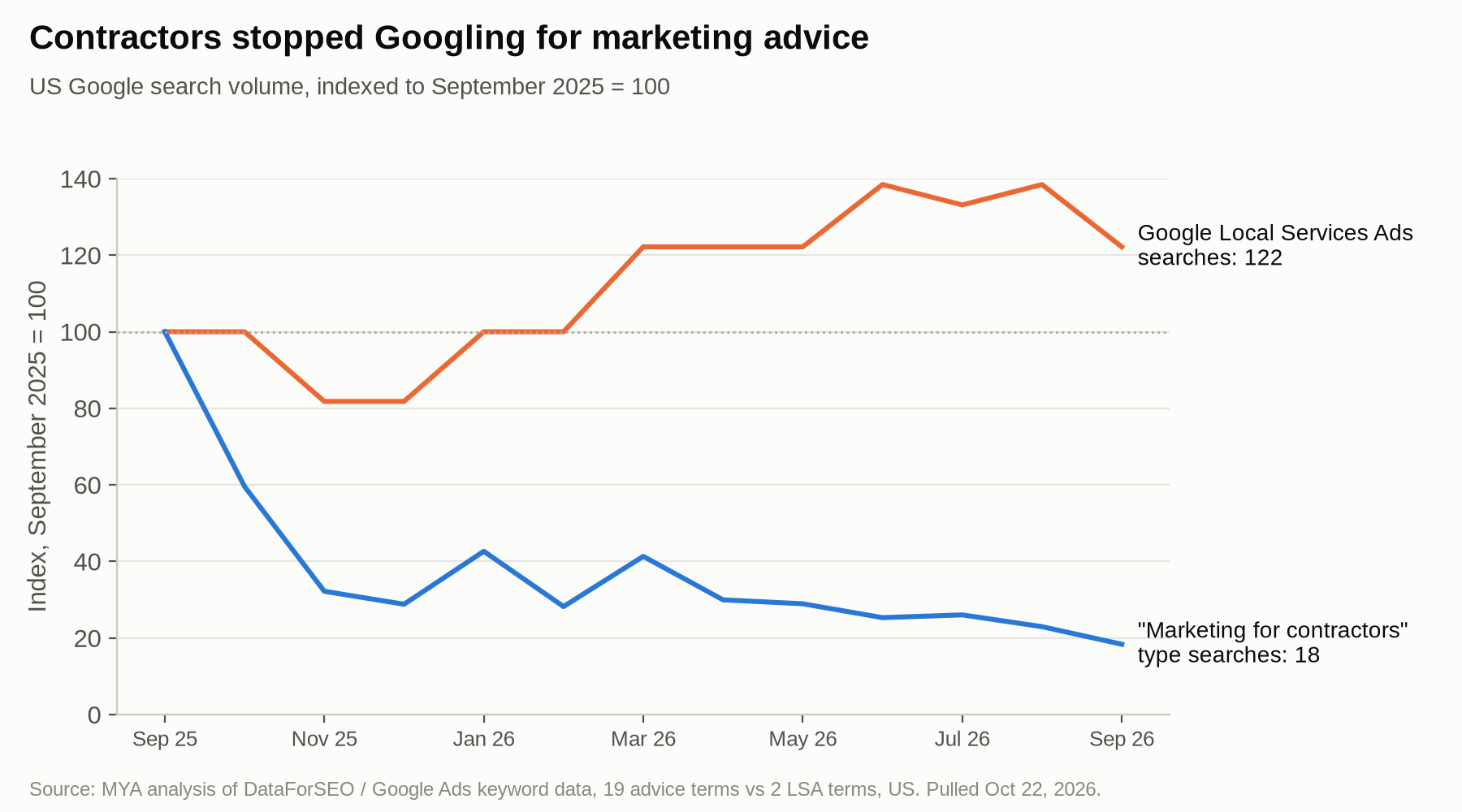
I pulled 12 months of Google search volume for the terms contractors type when they look for marketing help ("marketing for contractors", "SEO for contractors", "lead generation for contractors" and 16 similar phrases). Combined monthly searches fell from 16,550 in September 2025 to 3,040 in September 2026, an 82% drop, and 40% comparing the last 12 months with the 12 before. These are Google's rounded estimates, so read them as a direction. The direction is obvious. Over the same period, searches for "local service ads" rose from 40,500 to 49,500 a month.
The homeowner side is moving the same way:
- BrightLocal's 2026 Local Consumer Review Survey (published February 11, 2026, 1,002 US adults) found that use of AI tools to get local business recommendations jumped from 6% to 45%, making it the third most used source.
- Scorpion's 2026 homeowner report (February 19, 2026) found 83% of homeowners start their search online and 22% use AI tools such as ChatGPT to find recommendations. 87% will not hire a business rated below four stars.
- Google says AI Mode has passed 1 billion monthly users (Sundar Pichai, July 22, 2026).
- Ahrefs (February 4, 2026) found that when an AI Overview appears, the top-ranking page gets a click-through rate about 58% lower.
Blog posts still matter, arguably more than before. AI tools recommend businesses they can find detailed, specific information about. Project pages with real budgets, process explanations, service-area pages and articles that answer real homeowner questions are the raw material AI answers are built from. So keep writing, and get more specific.
Demand generation or demand capture: which channel fits which job?
This explains why the same channel works brilliantly for one contractor and flops for another.
Demand capture means showing up when someone is already looking. A homeowner with a leaking shower types "bathroom remodel near me" into Google. They have the problem today, they want it fixed soon, and whoever shows up first with good reviews gets the call. Google Search, Local Services Ads and Google Maps are demand capture.
Demand generation means creating the desire before someone searches. Nobody wakes up and searches "design-build firm for a $900,000 whole-home renovation." They see a video of a finished project in their area, from an owner who explains the process honestly, and six weeks later they are ready to talk. Meta (Facebook and Instagram), YouTube and, increasingly, AI recommendations are demand generation.
Google Search and Local Services Ads: best for urgent, smaller jobs
Google works extremely well when the job is urgent and the scope is clear: repairs, replacements, single-room remodels, anything a homeowner needs done in the next 90 days. It works less well for large, discretionary projects, because the volume of people searching for them in any one service area is tiny.
What changed in 2026:
- Missed calls now cost money on Local Services Ads. Starting October 1, 2026, Google charges missed calls during business hours as valid leads if the caller stays on the line for more than 20 seconds (reported by Search Engine Roundtable and PPC Land from Google's advertiser email, August 2026). If nobody answers your phone, you now pay for that too.
- Local Services Ads are moving into Google Ads. From August 2026, selected US home-service categories began running LSA inside Google Ads as a Performance Max format, still pay per lead, with manual bidding removed and historical reports not carried over (PPC Land, July 20, 2026).
- Lead forms are becoming conversations. At Google Marketing Live in May 2026, Google announced ads inside AI Mode and a "Business Agent for Leads" that replaces a static form with a chat inside the ad.
The Invoca 2026 home services benchmark adds the uncomfortable part: only 52% of inbound calls reach a person, and 55% of businesses never ask the caller to book or buy. With Google now billing missed calls, an unanswered phone is a direct cost.
Meta (Facebook and Instagram): best for large, discretionary projects
Meta is where design-build firms find clients before those clients start searching. For additions, ADUs, whole-home remodels and custom homes, this is where most of the volume in our accounts comes from in 2026.
Meta's delivery system also changed. On its July 29, 2026 earnings call, Meta said it deployed its first generative model in ad retrieval, with 8.3% more ad clicks and a 15.7% uplift in conversions on Facebook, and Advantage+ campaigns passed a $75 billion annual run-rate. Meta now decides who sees your ad mostly from the ad itself. Your creative is your targeting.
Lead marketplaces: Angi, HomeAdvisor, Thumbtack and Houzz Pro
Marketplaces sell leads that are often shared with several competitors. They can fill a calendar for a newer company, but they rarely build a premium design-build business, because the homeowner is comparing three or four quotes from the start.
The 2026 picture:
- Angi is shrinking and restructuring. In its Q2 2026 results (August 4, 2026), revenue was $248.0 million, down 11% year over year, average monthly active service professionals fell 17% to 106,000, and leads fell 13%. The company took a $235.2 million impairment. On September 22, 2026, Angi named Michael Steib CEO with a mandate to "use the revolutionary power of AI" and "move with urgency." Angi also launched an "AI Front Desk" beta in July 2026 to automate pros' lead follow-up and scheduling.
- Thumbtack moved into AI assistants. In April 2026, Thumbtack announced a home services experience inside Anthropic's Claude and a new AI-powered homeowner experience.
- Houzz Pro added AI mobile tools for pros in 2026, and remains strongest for design-led remodelers who already have a strong portfolio. We broke down the trade-offs in more detail in is Houzz worth it for builders.
My view: use marketplaces as a supplement if you are under capacity and need jobs this month. Do not build your business on leads you do not own and that three competitors also received.
Referrals, Google Business Profile, SEO and AI search
Referrals still close at the highest rate of any source, because trust arrives with the lead. The problem is that you cannot turn them up when you need more work. Build a simple referral ask into job closeout, and keep a list of past clients you contact twice a year.
Your Google Business Profile, reviews and website are the foundation every other channel leans on. A homeowner who sees your Meta ad will Google you before they book. If they find 11 reviews and a website with stock photos, you lose them.
Channel comparison
What kind of ads actually work for contractors right now?
Usually not the ones contractors expect. In our 2026 accounts, the cheapest qualified leads rarely came from the most polished ads. They came from simple, honest ones.
Three examples from this year:
- A kitchen and bath company: the owner's own talking-to-camera video produced 10 of 16 leads in September 2026 at about $48 each. A second simple video with a different presenter produced six leads at about $26. A third video did not get a single lead on about $167, and Meta moved the budget to the two that worked.
- A Miami home-additions firm: the winning ad simply explained the firm's core difference: one triple-licensed team handles the whole project. It produced about 81 leads at $28.55 each, beating every short-form variant. A myth-busting video that named the homeowner's exact fear ("I'll just manage it myself") came second at about $42.
- A Los Angeles ADU builder: the hook "This 400 square foot ADU in LA pays for itself in under three years. Let me show you how we built it" took almost the entire budget and produced 29 leads at $51.18. A scarcity-based ad ("limited spots") in the same account was the most shown and the worst performer, at $164 per lead.
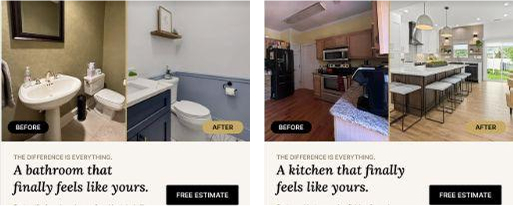
Compare that with the format most contractors default to: the before-and-after image with a "free estimate" button. Below are two from 2026 accounts. They look professional, and neither is a proven winner. In the window we checked, the kitchen version reported 2 website leads at $119.80 each, and the bathroom version had spent only $20.93 with no leads yet. Everybody runs before-and-afters. They show the finished kitchen. They don't show who built it, or why a homeowner should trust them.
Meta is also doing more of the creative work itself. When we previewed an ad on October 22, 2026, Ads Manager showed a "Ways your ad will be seen" panel with automatic variations: a Facebook Collection, a video slideshow and Instagram Stories with varied aspect ratios, which Meta says it uses to "improve performance and prevent creative fatigue." Meta will remix what you give it. What it cannot invent is a real owner saying something true about your projects.

Outside data points the same way. TikTok reported in November 2025 that creator-style ads get 70% higher click-through at the same cost per thousand impressions. Brainlabs' analysis of Meta brand lift studies found lo-fi, native-looking creative lifted purchase intent more than average, while polished creative did better on pure awareness.
The ad that wins is usually the owner, on a real job site, saying something true and specific. Homeowners are hiring a person, not a production company.
The winners in our accounts share four things:
- A real person from the company, ideally the owner or the designer the client will actually work with.
- A specific number or claim a homeowner can check: a payback period, a timeline, a price range, a license, a project in their area.
- The homeowner's real fear, said out loud: going over budget, the project dragging on, managing five subcontractors.
- One clear next step: book a consultation, see the project, get a range.
What tends to lose: generic "transform your home" copy, stock footage, fake urgency, and anything that could have been made by any contractor in any city.
How do you qualify leads when people lie on forms?
They do lie, and not always on purpose. Homeowners understate budgets to avoid being upsold, overstate them to be taken seriously, or have no idea what a project costs in 2026. A single budget dropdown is a thin signal. If you hard-disqualify everyone who picks the lowest option, you will throw away real projects. If you trust it blindly, your calendar fills with tire kickers who cannot afford you.
So qualify on signals that are harder to fake, then confirm with a short phone call.
Qualifiers that are harder to fake than budget
- Location, down to the zip code. Ask for the property zip code and check it against your service area and the neighborhoods your past projects sit in. A zip code tells you more about likely budget than any dropdown, and it is something people rarely lie about.
- Project size in square feet or rooms. "How large is the space?" or "Roughly how many square feet is the addition?" A 400 square foot ADU and a 2,000 square foot addition imply very different budgets, whatever box they ticked.
- Stage in the process. "Do you have plans or drawings? Do you own the lot? Have you spoken to an architect or lender?" Someone with plans and financing is months ahead of someone with a Pinterest board.
- Timeline. "When would you like construction to start?" Under three months, three to twelve months and "just exploring" are three different follow-up tracks.
- Investment range, framed honestly. Instead of "What is your budget?", show realistic ranges for the project type: "Most whole-home renovations we build fall between $250,000 and $600,000. Which range fits what you have in mind?" Anchoring with real numbers filters better than an open question.
- Decision makers. "Who else will be part of the decision?" Two spouses on the first call close far more often than one.
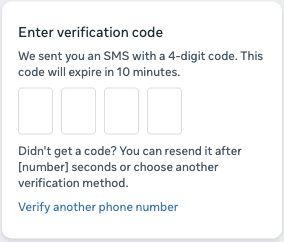
- Phone verification. One of our Miami builder clients requires every lead to verify their phone number before the form submits. Cost per lead runs higher (about $96), but every lead is a real, reachable person.
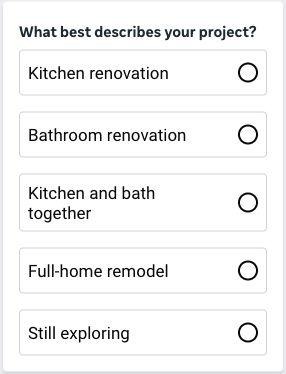
Two of those on a real Meta instant form: a project-type question that sorts leads before anyone picks up the phone, and the phone verification step.
Use a triage call instead of a hard filter
For one client, two qualifiers ran on every form: stage in the process and investment range. The question was whether to automatically block low answers from booking. Our recommendation was no. Keep the form open, and run every lead through a short triage call before the real sales consultation.
A triage call takes five to ten minutes. It confirms the address, the scope, the timeline, the rough budget and who decides. It separates the serious homeowners from the curious ones without turning anyone away at the door, and it means your senior people only spend an hour with families who can actually go ahead.
Log why leads were lost
In that same account, 46% of leads were marked "Lost" with no reason recorded. That makes it impossible to know whether to fix targeting (wrong people) or follow-up (right people, never reached). Make "lost reason" a required field: wrong area, wrong project type, budget, no response, chose someone else, not ready. After 60 days, those reasons tell you exactly which new qualifier to add.
Speed to lead: where do most paid leads die?
This was the biggest leak in our 2026 data. It's also the cheapest one to fix.
In the client reports between June and September 2026 that recorded it, the share of paid leads still sitting untouched in the "New Leads" stage was 35%, 71%, 78%, 88% and 89%. One account had 31 conversations waiting for a reply and 57 unread messages in a single month.
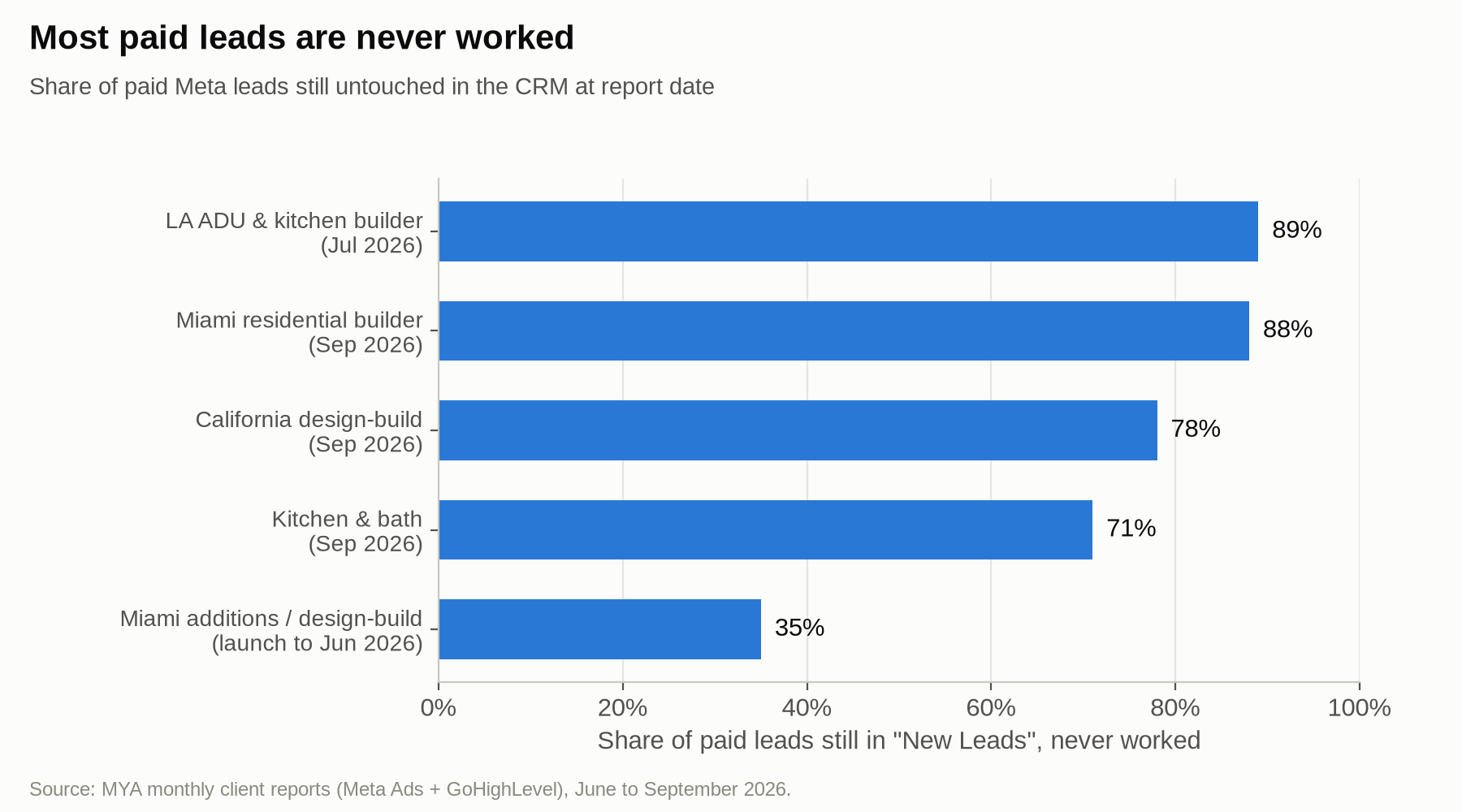
Compare cost per lead with cost per booked call. The cheapest booked calls didn't come from the cheapest leads. They came from the accounts that called their leads.
The "five-minute rule" is older than most people think. It comes from a 2007 study by InsideSales.com and MIT, which found the odds of contacting a lead were 100 times higher, and of qualifying it 21 times higher, when the lead was called within five minutes instead of 30. A 2011 Harvard Business Review study of 2,241 companies found the average response time to a web lead was 42 hours. The numbers are old. The behavior has not changed. In home services, Invoca's 2026 benchmark found only 52% of calls even reach a person.
A speed-to-lead process that works for a contractor
- One named owner for the inbox. Not "the office". A person, with backup for days off.
- Instant automatic text when the form submits: who you are, that you will call in the next few minutes, and a link to book directly if they prefer.
- A call within five minutes during business hours. Use the call to book the consultation on the spot, or to run the triage questions.
- A same-day second attempt if they do not pick up, then a short sequence over the next seven days: call, text, email, call.
- Mark every outcome in the CRM: reached, booked, not a fit, no answer. You cannot improve a stage you are not measuring.
Google now bills you for missed Local Services Ads calls. Angi is building an AI front desk to answer leads for pros. Both are betting that contractors don't pick up.
Why don't booked homeowners show up?
No-shows aren't random. In my experience there are two causes. The homeowner doesn't understand the logistics of the call, or doesn't trust you enough yet to give up an hour of their evening. Fix both before the appointment.
Fix the logistics gap
Many homeowners book a "consultation" without knowing what it is. Is someone coming to the house? Is it a video call? Do both spouses need to be there? Do they need drawings? How long will it take? Will they get a price?
Your confirmation sequence should answer all of that in plain language:
- Who they are meeting, with a name and a photo.
- When and where: date, time, and whether it is on site, by phone or by video, with the link.
- What happens on the call: "We will walk through your project, talk about budget ranges for similar work in your area, and explain how our design-build process works."
- How long it takes.
- What to have ready: photos of the space, any plans, rough budget, everyone who will be part of the decision.
- Reminders the day before and an hour before, by text, with an easy way to reschedule instead of disappearing.
Fix the trust gap
A homeowner who booked from an ad has known you for minutes. Between booking and the call, give them reasons to believe you are the right firm:
- A short video from the person they will meet, explaining what the call is and is not.
- One or two case studies from projects like theirs, ideally in their area, with real budgets and timelines.
- Your reviews. Scorpion's 2026 survey found 87% of homeowners will not hire a business rated below four stars.
- Proof of the things they are afraid of: how you handle change orders, how you keep a schedule, how you communicate during the build.
Do both and the homeowner turns up knowing what to expect and already half-convinced. Your close rate goes up along with your show rate.
{{banner-small-1="/banners"}}
Case studies: what this looks like in real accounts
All clients below are anonymized. Figures come from Meta Ads Manager and the client's own CRM.
A remodeler: $3,484 in ad spend, one $80,000 project
A remodeling company ran Meta campaigns at $50 a day across August and September 2026. In September it spent $2,331.23 for 16 leads at $145.70 each, and 3 of those leads booked a call (a 19% booking rate, up from 8% in August), which put cost per booked call at $777.08.
On cost per lead, that account looks expensive. Then one of those ad leads signed an $80,000 construction project. Total ad spend over the two months: $3,484.
A Miami home-additions firm: from leads to jobs in delivery
A design-build firm in Miami-Dade, with projects ranging from about $20,000 to over $4 million, spent $6,454.79 from launch to June 29, 2026. It produced 173 leads at a blended $37.31, every one reconciling with the CRM. Lead volume grew month over month as budget increased: 10, 44, 56 and 72 opportunities from March to June.
By the end of June, 22 leads had booked appointments and 7 deals were in "Pending Service Completion", meaning won and in delivery. That works out to about $922 in ad spend per deal won. A single home addition at that firm covers the entire ad spend many times over.
It still leaked: 35% of leads untouched, 46% marked lost with no reason, and no project values in the CRM, so nobody could calculate return on ad spend exactly.
A kitchen and bath company: first month
In its first month (September 2026), a kitchen and bath company spent $1,131.07, generated 17 leads at $66.53 and booked 5 consultations, a 29% booking rate and $226.21 per booked call. The owner's own video drove most of the results. Even so, 12 of 17 leads were still sitting in "New Leads" at month end. That's next month's upside.
Want these numbers for your own firm? MYA runs this system for design-build firms, remodelers and custom builders. Book a call with our team here and we'll walk through your leads, your close rate and what a job is worth to you.
How do you connect lead generation to job costing?
You can't know which lead source is profitable until you know what each job actually cost to build.
The closed loop, step by step
- Tag every lead with its source at the moment it enters your CRM: Meta campaign, Google, LSA, referral, marketplace, website.
- Mark every stage: reached, booked, showed, proposal sent, signed, lost (with a reason).
- Enter a value at proposal and the signed contract value at close.
- Carry the source into your project management system when the job is created, whether that is JobTread, Buildertrend or something else, and make sure it connects to your payroll and accounting.
- Track actual costs against the job: labor at its real burdened cost from payroll, materials, subcontractors and equipment, using consistent cost codes.
- At closeout, calculate gross profit per job and report it by lead source.
- Review monthly: cost per lead, cost per quality conversation, show rate, close rate and gross profit per job, side by side, by channel.
Step five is the one that usually breaks. Hours live in a time app, pay rates and burden live in payroll, and the job lives somewhere else. If the labor number posted to the job is an estimate rather than what payroll actually paid, your profit per job is wrong, and so is every marketing decision you make from it.
Once the loop is closed, the conversation changes. "Meta leads are too expensive" becomes "Meta leads cost us $1,100 per signed job at a 31% gross margin, marketplace leads cost $600 at 18%." Now you can actually decide.
Verdict: buy profitable jobs, not cheap leads
There's no secret channel for lead generation for contractors in 2026. Spending is flat, homeowners search through AI, and the platforms run the targeting. The firms that grow are disciplined from the ad all the way to the job cost:
- Match the channel to the project: Google for urgent, smaller jobs, Meta for large, discretionary ones.
- Use simple, honest, specific creative from real people in your company.
- Qualify with signals that are hard to fake, and confirm with a triage call.
- Call every lead within minutes, and mark every outcome.
- Close the logistics gap and the trust gap before every consultation.
- Set your budget from gross profit per job, and judge high-end campaigns on a six to twelve month horizon.
Do that and you'll stop worrying about cost per lead. You'll be looking at profit per job instead.
Want help building this? If you'd rather have it done for you, from the ads to the follow-up to the booked consultations, schedule a call with MYA here. We'll look at your numbers and tell you straight whether we can help.
FAQs
What is the five-minute rule for leads?
The five-minute rule says you should contact a new lead within five minutes of it coming in. It comes from a 2007 InsideSales.com and MIT study, which found contact rates were 100 times higher and qualification rates 21 times higher at five minutes compared with 30 minutes. In our 2026 contractor data, the biggest losses came from leads never being contacted at all, so a same-day process with one named inbox owner is the first step.
How much should a contractor pay for leads?
For $5,000 to $50,000 projects, $15 to $50 per lead and $100 to $300 per quality conversation is a healthy range. For larger projects, leads cost more and that is acceptable. Set your ceiling from your own numbers: gross profit per job, times the share you are willing to spend to win it, times your close rate.
Is it worth paying for contractor leads?
Paying for exclusive leads from your own ads usually beats buying shared leads, because you are not competing with three other contractors from the first call. Shared marketplace leads can help fill a calendar quickly, but they rarely build a premium design-build business. Either way, judge them on cost per signed job and gross profit, not cost per lead.
Are Angi leads still worth it in 2026?
They can fill short-term gaps, but the platform is in transition. In Q2 2026 Angi's average monthly active pros fell 17% and leads fell 13%, and it appointed a new CEO in September 2026 to lead an AI-focused turnaround. If you use Angi, respond within minutes, track cost per signed job, and do not let it become your only source.
Are Google Local Services Ads worth it for contractors?
For trades with urgent, clear-scope work, often yes. Be aware of the 2026 changes: from October 1, 2026, missed calls during business hours that last more than 20 seconds are billed as leads, and LSA is moving into Google Ads as a Performance Max format. If you cannot answer the phone reliably, fix that first.
How do general contractors and design-build firms get leads?
The most reliable mix in 2026 is Meta ads for large projects, Google Search and Local Services Ads for urgent work, a strong Google Business Profile with recent reviews, a website with real project pages, and a referral process built into every job closeout. Track all of them back to gross profit per job.
What is a reasonable cost per lead for a remodeler?
On Meta, WordStream's 2026 benchmark for home and home improvement is $42.95, and our residential remodeling accounts run from about $37 to $146 depending on project size and market. On Google Ads, the 2026 benchmark is $90.92. A "reasonable" cost per lead is whatever still leaves you profitable after close rate and margin.
Should contractors still write blog posts now that AI answers so many searches?
Yes. BrightLocal found 45% of consumers now use AI tools for local business recommendations in 2026, and those tools recommend businesses they can find specific, detailed information about. Project pages, process explanations and answers to real homeowner questions are what AI answers are built from.
About the author
Sebastian Hardy is the founder of MYA (Market Your Architecture), which runs paid acquisition and sales systems for residential design-build firms, remodelers, kitchen and bath companies and custom builders across the US.
Sources
- Harvard Joint Center for Housing Studies, LIRA press release, October 22, 2026: https://www.jchs.harvard.edu/press-releases/remodeling-spending-continues-stagnate
- NAHB, Remodeling Market Index Q3 2026, October 8, 2026: https://www.nahb.org/news-and-economics/press-releases/2026/10/remodeling-market-sentiment-remains-stable-in-third-quarter-despite-headwinds
- NAHB, builder sentiment October 2026, October 19, 2026: https://www.nahb.org/news-and-economics/press-releases/2026/10/builder-sentiment-falls-on-rising-rates
- Freddie Mac 30-year fixed rate via FRED: https://fred.stlouisfed.org/series/MORTGAGE30US
- Angi Q2 2026 earnings release, August 4, 2026: https://www.sec.gov/Archives/edgar/data/0001705110/000170511026000077/q22026earningsrelease.htm
- Angi CEO appointment (SEC filing), September 22, 2026: https://www.sec.gov/Archives/edgar/data/1705110/000110465926109801/tm2625987d1_ex99-1.htm
- PPC Land, LSA missed-call charges from October 1, 2026: https://ppc.land/google-lsa-advertisers-face-missed-call-charges-from-october-1/
- Search Engine Roundtable, LSA missed calls: https://seroundtable.com/google-lsa-missed-subsequent-calls-41940.html
- PPC Land, LSA folded into Google Ads, July 20, 2026: https://ppc.land/google-folds-local-services-ads-into-google-ads-cuts-historical-reports/
- Google Marketing Live 2026: https://blog.google/products/ads-commerce/google-marketing-live-search-ads/
- Alphabet Q2 2026 CEO remarks: https://blog.google/company-news/inside-google/message-ceo/alphabet-earnings-q2-2026/
- Meta Q2 2026 earnings call transcript, July 29, 2026: https://s21.q4cdn.com/399680738/files/doc_financials/2026/q2/META-Q2-2026-Earnings-Call-Transcript.pdf
- WordStream Facebook Ads benchmarks 2026: https://www.wordstream.com/blog/facebook-ads-benchmarks-2026
- WordStream Google Ads benchmarks 2026: https://www.wordstream.com/blog/2026-google-ads-benchmarks
- BrightLocal Local Consumer Review Survey 2026: https://www.brightlocal.com/research/local-consumer-review-survey/
- Scorpion 2026 homeowner report: https://www.scorpion.co/about-us/scorpion-news/scorpion-news/2026/scorpions-new-industry-report-reveals-a-disconne/
- Ahrefs, AI Overviews and clicks, February 2026: https://ahrefs.com/blog/ai-overviews-reduce-clicks-update
- Invoca home services lead conversion benchmarks 2026: https://invoca.com/reports/the-invoca-home-services-lead-conversion-benchmarks-report-2026
- InsideSales.com and MIT lead response study, 2007: https://www.mortech.com/hs-fs/hub/25649/file-13535879-pdf/docs/mit_study.pdf
- Harvard Business Review, "The Short Life of Online Sales Leads", 2011: https://hbr.org/2011/03/the-short-life-of-online-sales-leads
- TikTok, creator ads performance, November 2025: https://ads.tiktok.com/business/en-US/blog/tiktok-creator-advantage
- Brainlabs, Meta brand lift studies: https://www.brainlabsdigital.com/meta-brand-lift-studies-objectives-creatives-results/
- Thumbtack in Claude, April 23, 2026: https://www.businesswire.com/news/home/20260423884720/en/Thumbtack-Delivers-Home-Services-Experience-in-Anthropics-Claude
- Houzz Pro AI mobile tools, 2026: https://www.pmmag.com/articles/107524-houzz-pro-introduces-new-ai-powered-mobile-tools
- Google search volume data: DataForSEO keyword data, US, September 2025 to September 2026, pulled October 22, 2026.
- Client data: Meta Ads Manager and client CRM (GoHighLevel) reports prepared by MYA, June to September 2026, anonymized.
- Screenshots: Meta Ads Manager, four contractor accounts (Contractors A to D), January 1 to October 21, 2026 and September 22 to October 21, 2026, captured October 22, 2026, cropped to remove identifying details. No figures altered.