
Job Costing Software for Construction: All-in-One vs. Best-of-Breed
How do construction companies manage labor costs, payroll and job costing in one system?
Most of them don’t, and the ones that try usually regret it. Labor is as much as 40% of project cost in construction, and the numbers that describe it live in three places: the time-tracking tool the crews use, the payroll system that pays them, and the accounting system that holds the job ledger. A company manages all three as one system when labor data moves between them automatically, so that hours logged in the field become fully burdened labor cost on the job the day payroll runs.
That is what Dapt does. It connects the time tracking, payroll and accounting systems a company already uses (ADP, Paychex, QuickBooks, Sage, JobTread and others), calculates the fully burdened cost of every hour and posts it to the job in the general ledger, with certified payroll and union reports produced from the same record. The alternative is a single all-in-one platform. This article compares the two.
The reality of a single-platform solution
A single platform promises one database and one source of truth. In practice, asking the field crews, the payroll department and the accounting team to work in the same system means each of them works in a system built for someone else. The field tool has to be the one the crews will use on a phone at the end of a shift. The payroll system has to be the one that handles prevailing wage and union fringe correctly. The ledger has to be the one the accountant already knows. One platform rarely wins all three.
The compromises show up in predictable places: low adoption in the field, custom configuration in payroll, and months of implementation before anyone sees a job cost report.
{{banner-large-cp="/banners"}}
The best-of-breed alternative
A best-of-breed stack lets the company pick the strongest application for each function and keep it:
- Accounting and general ledger: QuickBooks, Sage Intacct or Microsoft Dynamics 365 Business Central
- Payroll: ADP, Paychex, Paycom or Paylocity
- Time tracking and field management: QuickBooks Time, ClockShark, eBillity, MakeShift, JobTread, and many others
Nothing is replaced, so there is nothing for the crews or the accountant to relearn. The stack behaves as a single system only if labor data moves between the three without being typed twice. That is Dapt’s job.
Time tracking is where job costing starts
Every number in a job cost report begins as an hour someone recorded in the field, against a job and a cost code. If that record is late or wrong, nothing downstream can fix it. So the field tool is the one choice in the stack the crews make, not the office: the app they will open at the end of a shift, on a phone, with the job list in front of them. Three things to get right when picking a time tracking system for job costing covers the choice.
Dapt takes the time as it is recorded. QuickBooks Time syncs every five minutes; JobTread sends each entry as it is saved. Dapt reads every recorded hour, whether or not it has been approved, so payroll is built on the hours that were worked rather than on the ones that have been signed off. For QuickBooks Time, employee records flow from payroll into the time system so a new hire appears in the field tool without being typed twice, and a correction made in Dapt is written back to the time record, so the timesheet, the payroll and the job cost agree.
How Dapt unifies the stack in real time
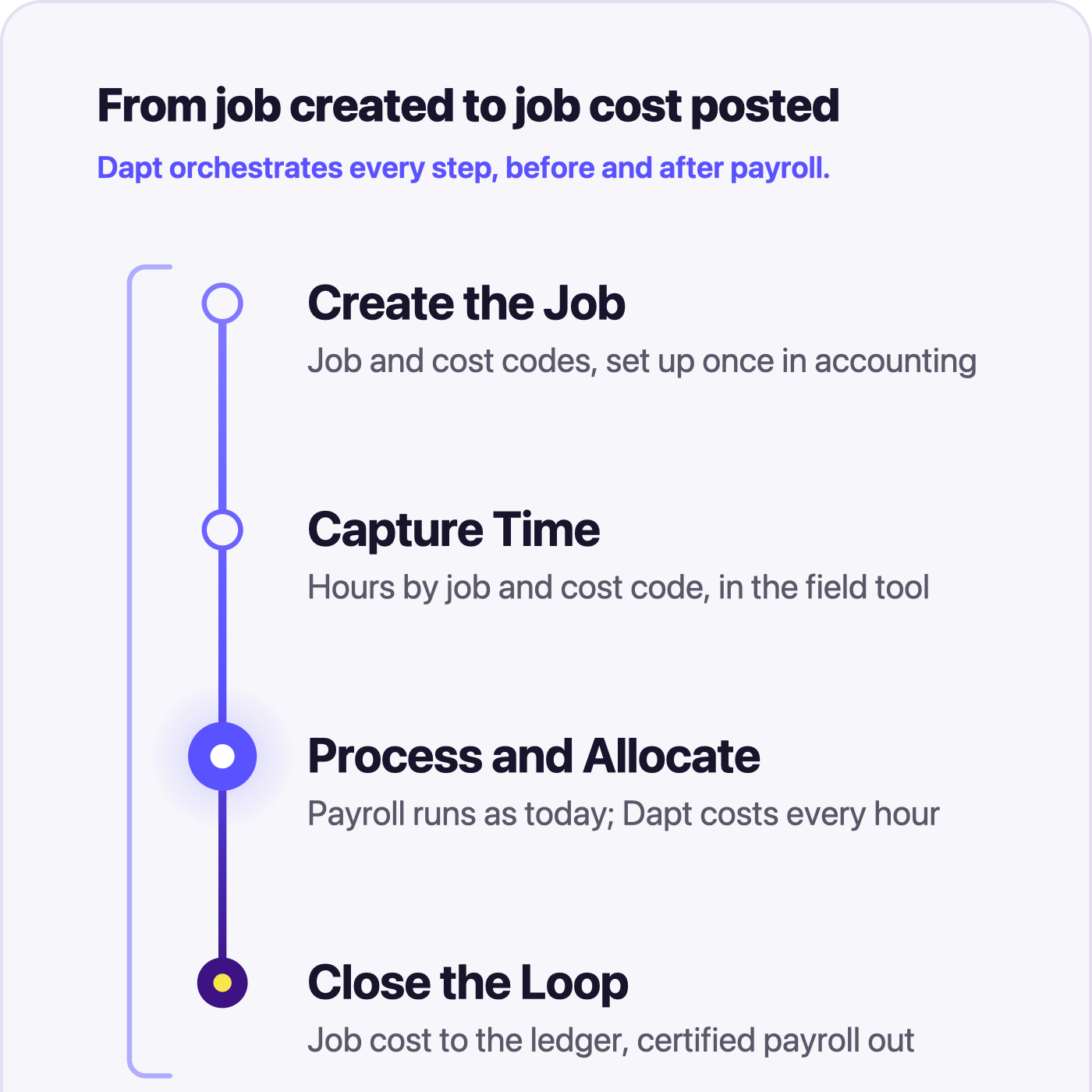
Dapt connects the field timesheets, the payroll processor and the accounting system, and moves labor cost through them in four steps:
- Create the job. The job and its cost codes are set up once, in the accounting system.
- Capture time. Crews log hours against those jobs and cost codes in the field tool they already use.
- Process and allocate. Dapt prepares the hours for payroll and, when payroll runs, calculates the fully burdened cost of every hour: wages, employer taxes, workers’ compensation and fringe.
- Close the loop. Dapt posts the burdened cost to the job, phase and cost code in the general ledger and produces the certified payroll report, federal or state, from the same payroll record.
The result is a P&L by job that reflects payroll as of the last pay run, not the last month-end close. A NYC-area jobsite safety company with 100 or more workers, union and non-union, runs this flow between ADP Workforce Now, QuickBooks Time and QuickBooks Online.
Side-by-side: single platform vs. best-of-breed with Dapt
What the company gets
1. Fully burdened labor cost on every job
Dapt does not pass an hourly wage into accounting. It calculates the cost of the hour, including employer payroll taxes, workers’ compensation, union fringe and overtime premium, and posts that cost to the project phase or task it belongs to.
2. Certified payroll without re-entry
On Davis-Bacon and prevailing wage work, Dapt maps job classifications, prevailing wage rates and fringe credits from the payroll data into the certified payroll report the project requires: the federal WH-347, each state’s own form, and the portal upload for states such as California that require electronic filing. One payroll record covers federal, state and local requirements, and union reporting comes from the same record.
3. Margin decisions while the job is still open
Because the flow from timesheet to payroll to ledger is automatic, the finance team stops reconciling spreadsheets, which saves 10 to 15 hours a week. Project managers see actual labor cost while the job is open, early enough to correct course before the margin is gone.
Verdict: keep the tools, connect the data
A single-platform ERP asks every department to give up the tool that works for it in exchange for one database. A best-of-breed stack connected by Dapt keeps the field tool the crews use, the payroll system the company trusts and the ledger the accountant knows, and turns hours in the field into fully burdened job cost on every pay run, with certified payroll and union reports from the same data. Nothing is replaced, and the job cost report is current the day payroll runs.
{{banner-small-1="/banners"}}
Frequently asked questions
Do we have to replace our accounting or payroll system to get job costing? No. Dapt connects the systems already in place. The job is created in the accounting system, time is captured in the field tool, payroll runs where it runs today, and Dapt moves the labor cost between them.
Which systems does Dapt connect to? Accounting: QuickBooks, Sage Intacct and Microsoft Dynamics 365 Business Central. Payroll: ADP (RUN Powered by ADP, ADP Workforce Now® and ADP TotalSource®), Paychex, Paycom and Paylocity. Time tracking and field management: QuickBooks Time, ClockShark, eBillity, MakeShift and JobTread. The full list is on the integrations page.
How long does it take to set up? Historically our implementations have taken 2 to 6 weeks. The work is mapping jobs, cost codes and pay rules between the systems that already hold them. A multi-state electrical contractor with more than 20 unions had ADP and QuickBooks connected in five weeks.
Talk to us
Connect with our team for a guided technology discovery session. We know this stack well and can walk through how it would fit your payroll workflows, and what real-time job costing would look like for your jobs without changing how your teams work. Contact us to get started.