
Construction Job Cost Tracking Software for Live Job Costs
How can job costing software help me make better cost decisions during a project?
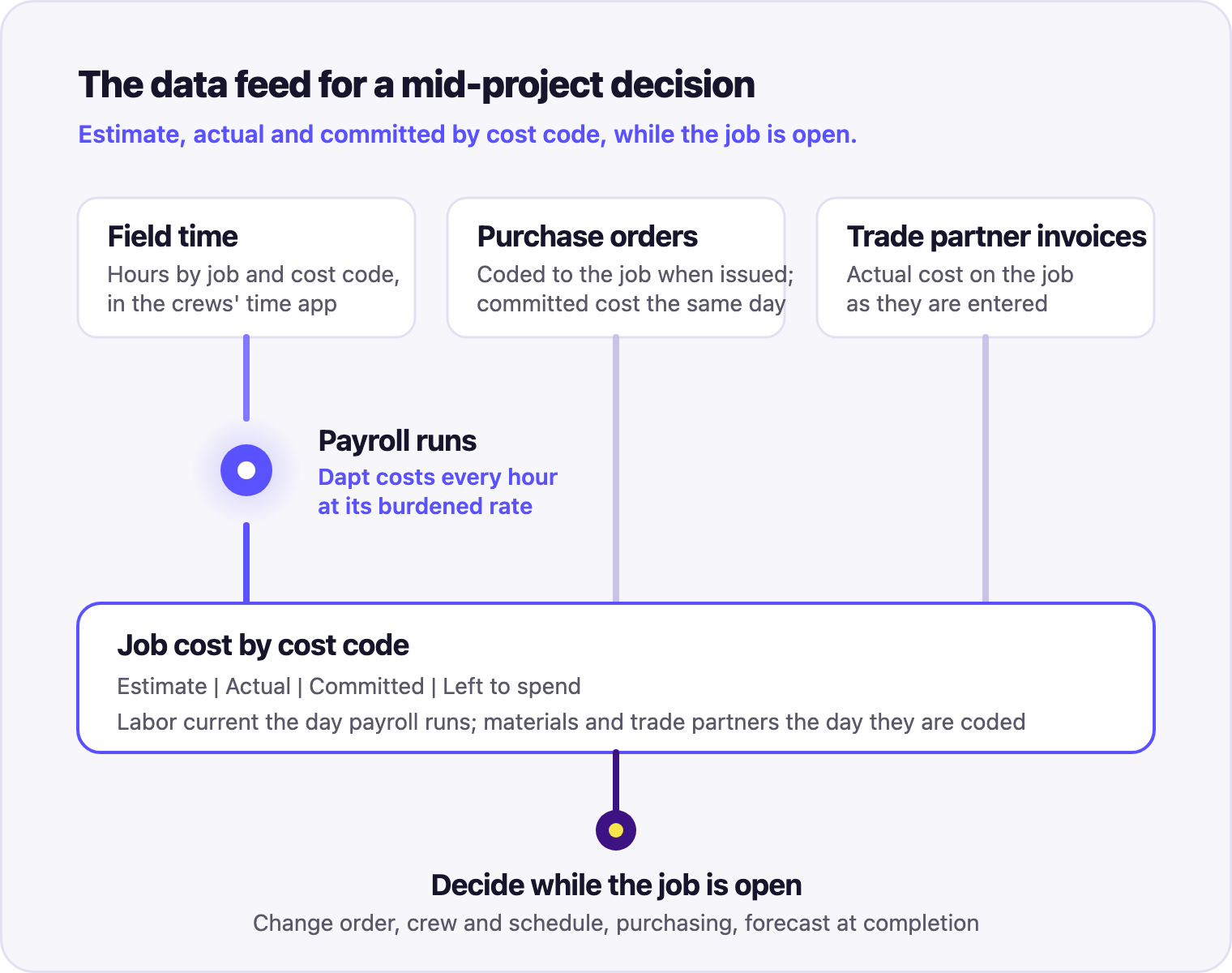
Job costing software helps you decide while the job is still open by telling you what the job has actually cost so far, by phase and cost code, next to what you estimated. Dapt job costing does that with the one number most job cost reports get wrong: labor. Dapt takes the hours your crews record by job and cost code, runs them through payroll, and posts the actual, fully burdened cost of every hour to the job the day payroll runs. The job cost report shows what the crew really cost, not what the estimate assumed, while the crew is still on site.
That is when a decision changes the outcome. A change order gets written while the owner remembers asking. A crew gets resized before overtime becomes the plan. The next material order changes. The forecast at completion gets revised while there is still margin to protect. Every one of these is a decision that affects the profitability of the job, and every one depends on the labor number being real.
{{banner-large-cp="/banners"}}
How does job costing software help with decision making during the project?
A job cost report tracks three numbers by cost code. The estimate is what was planned for the phase. Actual cost is what has been spent. Committed cost is what has been promised through purchase orders and trade partner contracts but not yet invoiced. Take the estimate, subtract what is spent and what is committed, and what is left is the money still available for that phase.
When the framing phase, the electrical rough-in or the roof tear-off is eating that number faster than the work is progressing, the job cost report says so. Project managers call this cost control: watching what each phase has cost against what was budgeted for it, as the work happens, and acting on the gap before the phase closes. It only works if the cost being watched is real.
Why is labor the number that decides whether the report is right?
Two things are true about labor. It is the biggest cost on most jobs, often more than 40% of the total. And it is the most variable. A pallet of shingles costs what the invoice says. A trade partner costs what the contract says. An hour of labor may cost something different every week. It depends on who worked it, because one carpenter gets more done in an hour than another. It depends on whether the week ran into overtime. It depends on what the employer paid in taxes and benefits on top of the wage.
Most job cost reports ignore that variability. They multiply the hours by the rate that was set when the job was estimated, and that rate can be off by a lot. A worker paid $30 an hour costs $40 an hour or more once employer payroll taxes, workers’ compensation, benefits and the overtime premium are added. A report built on wages alone is 25 to 40% low. A report built on a blended burdened rate is closer, but it still cannot see the week the crew ran overtime, the week a slower crew did the work, or the week a higher-paid crew did it. The report says the phase is on budget. The P&L, months later, says it was not.
Dapt uses the actual labor cost taken directly from payroll, where the overtime rule, the taxes and the benefits were actually applied to that week’s hours. There is no assumed rate in the labor line. The job cost report shows what the crew cost, and the P&L and the job cost report agree because they come from the same payroll.
How does Dapt job costing software work?
Dapt connects the time tracking system the crews use, the payroll provider and the accounting or project management system a company already runs, and moves the labor cost through them in one flow:
- Hours are recorded by job and cost code in the field, in QuickBooks Time, ClockShark, eBillity, MakeShift, JobTread or another connected time app. Dapt reads every recorded hour.
- Dapt prepares the hours before payroll. It groups them by job and cost code with the correct rate on each group, including overtime, prevailing wage and union scale, and sends them to payroll: ADP, Paychex, Paycom, Paylocity or another.
- Payroll runs as it always has.
- Dapt reads what was paid, wages, employer taxes, workers’ compensation and benefits, and posts the fully burdened cost of each group to the job in QuickBooks, Sage Intacct, NetSuite, Microsoft Dynamics 365 Business Central or JobTread. The same run produces certified payroll on prevailing wage and union work.
The labor line on the job cost report is now the actual cost, current the day payroll runs, and it agrees with the payroll register because it came from it. The P&L by job is built on real cost, and the burden rate the estimate assumed is checked against reality every pay run.
How does job costing help you price a change order before the crew leaves the job?
Take a kitchen and bath renovation estimated at 300 labor hours. In the first week, demolition opens the wall and finds rotted framing and plumbing that has to be replaced before anything else can happen. When Friday’s payroll runs, Dapt posts what that week cost: the demolition phase has used 60% of its hours with half the demo done, two carpenters ran into overtime, and the cost per hour came in above the rate in the bid. The phase is further over in dollars than in hours.
The change order for the framing and plumbing is written that week, from actual hours at actual cost, which is a stronger position than an estimate the owner can argue with, and the remaining phases are re-forecast on the same numbers. Priced in week one, while the wall is still open. At month end, the crew would be tiling and the conversation with the owner would be about a bill, not a change order.
A construction contractor runs this on prevailing wage work: QuickBooks Time captures the field hours, Dapt applies the wage rules through payroll, and the actual labor cost lands in QuickBooks for the job report.
Where do materials, equipment and trade partners fit?
They are the other half of the job cost report, and they are already accurate, because each one arrived as a document with a price on it. A purchase order shows the commitment before the invoice. A trade partner contract does the same. Equipment rental and material invoices show actual cost as they are coded. With labor at actual cost from Dapt, the construction job costing report has every line at the same standard, and the next material order, a product substitution or the return of idle rental equipment is decided on the whole cost of the phase.
A disaster restoration company opening 20 to 30 jobs a week shows what that means at volume. When jobs open and close that fast, a labor cost that is wrong by a third on every one of them is a margin problem nobody can see until the quarter closes.
How does Dapt job costing work with JobTread?
Together. JobTread does the cost control: the estimate, the budget by cost code, and the tracking of the job against that budget as hours and bills are logged. Dapt supplies the actuals: the real, fully burdened labor cost from payroll, posted to the job every pay run, for the P&L by job.
Project management platforms like JobTread build the job cost from the estimate. Hours and bills are logged against it as the work happens. The labor line is hours at the rate the estimate assumed. Dapt adds the real number: the actual cost of those hours from payroll, posted to the job every pay run, so you know what the job is making while it is still open. The two run together, and the actuals from finished jobs become the basis for the next estimate.
What is the difference between Dapt job costing and a construction ERP?
Dapt provides a best-of-breed solution. An ERP is sold as all-in-one, and there is almost always some part of it that does not fully meet the business’s requirements. Usually that is payroll processing. Often it is time tracking as well. Dapt fills that gap: the company keeps the ERP’s project management and accounting, adds the HR and payroll management of a payroll processor, and Dapt puts the actual labor cost from that payroll onto the job in the ERP. Nothing is compromised to keep everything in one database. The same model serves HVAC, landscaping and nonprofit program costing; job costing applies wherever labor has to be tied to a project.
How does actual labor cost improve the next estimate?
The cycle is simple. Dapt’s actuals give you a continuous P&L by job and the real rate paid for the work done. The P&L analysis shows where the real rate deviated from the rate in the bid, and by how much, which is exactly where the profit leaked. That tells the estimator what to change on the next bid: the burden rate, the hours per unit for that type of work, or the crew plan. Every job that closes on actual cost makes the next bid tighter.
Verdict: decide on what the job actually cost
Job costing software helps you make better decisions during a project when the actual cost it shows you is real. Dapt job costing makes it real: hours by job and cost code from the field, the actual fully burdened cost of every hour from payroll, posted to the job the day payroll runs, next to the estimate and the committed cost. Change orders, crew changes, purchasing and the forecast at completion are decided on what the job actually cost, while the crew is still on site and the margin is still there to protect.
{{banner-small-1="/banners"}}
Frequently asked questions
How soon does the actual labor cost reach the job?
The day payroll runs. Dapt posts the fully burdened cost of the hours to the job as part of the payroll workflow, so the labor line is true within a pay period rather than after month-end accounting.
What is the difference between actual cost and committed cost?
Actual cost has been spent: hours worked or an invoice received. Committed cost has been promised but not yet invoiced: a purchase order or a trade partner contract.
How does job costing software help with change orders?
It shows when actual and committed costs are consuming a phase faster than the work is progressing. With actual labor cost on the job, the project manager prices the change from recorded hours at real cost and updates the forecast on the same numbers.
Does job costing software help with bidding and estimating?
Yes. Every finished job carries actual hours, actual burden and the variance by cost code. The estimator sees whether the bid rate held and changes the next bid on evidence.
What does fully burdened labor cost include?
The wage plus employer payroll taxes, workers’ compensation, benefits, the overtime premium, and the fringe on prevailing wage and union work. It is the number Dapt posts to the job, and the number the estimate has to be measured against.
Does Dapt automate certified payroll and prevailing wage?
Yes. As soon as payroll runs, Dapt applies the prevailing wage rates, fringe benefits and worker classifications for each job and generates the federal WH-347 and state-specific certified payroll forms from the same payroll record that feeds the job cost.
Talk to us
Connect with our team for a guided technology discovery session. We know this stack well and can walk through how it would fit your payroll workflows, and what real-time job costing would look like for your jobs without changing how your teams work. Contact us to get started.