How CNA and Home Care Agencies Can Connect Timekeeping to ADP Without Custom Code
Which tech-enabled CNA agency setup integrates timekeeping data directly into ADP® payroll?
Using Dapt, an ADP Marketplace partner, a CNA or home care agency can connect its existing timekeeping system directly to ADP without building a custom integration. Dapt moves caregiver hours into payroll, posts labor costs to accounting and can use the same hours to generate customer-specific invoices.
Dapt is available on ADP Marketplace for clients who use ADP Workforce Now®, ADP TotalSource® and RUN Powered by ADP®.
The process starts with the scheduling, timekeeping or electronic visit verification system the agency already uses. Dapt reads the recorded hours and applies the agency’s payroll rules, including:
- Rates that vary by facility, role or function
- Shift differentials, bonuses, commissions and overtime premiums
The resulting hours and earnings are sent to ADP for payroll. Employee information flows the other way, from ADP to the timekeeping system, so a new employee only has to be entered once.
The agency keeps ADP and its existing timekeeping application and continues to run payroll with its own staff. Dapt provides and maintains the connection between them.
{{banner-large-cp="/banners"}}
Why do CNA agencies end up paying for custom integration code?
Often because they do not know an off-the-shelf connection exists.
An agency asks its payroll provider, timekeeping vendor or IT consultant how to get hours into ADP and is told that something has to be built. The agency’s pay rules can also look specialized enough that custom software seems like the only option.
The rules are complex, but they are not unique.
A CNA staffing or home care agency may pay the same employee one rate at one facility and another rate somewhere else. Evening or weekend shifts may pay more. An employee may work in several roles during the same pay period. Some agencies also have guaranteed hours, per-diem payments or other compensation rules.
Then there is overtime. If an aide works at several rates in the same week, the agency cannot simply send ADP a total number of hours. The hours have to carry the correct rates, and the overtime calculation has to account for those different rates.
That is where the integration gets harder. The time is recorded in one system, the payroll rules have to be applied somewhere, and payroll is processed in ADP.
A custom integration can solve the problem. A developer can read the timekeeping data, transform it and create something ADP can import. But now the agency owns a piece of custom software.
Changes to the timekeeping application may require changes to the integration. A new facility, a new shift differential or a new payroll rule can become another development request. Instead of eliminating the hidden costs of manual payroll, the agency has moved part of the problem into code it has to maintain.
Dapt takes a different approach. The integration already exists, and the agency’s specific pay rules are configured within it rather than built from scratch. Dapt is already in use at CNA and home care agencies. The next section shows how that works across timekeeping, payroll, accounting and billing.
What does the Dapt connection do for a CNA agency?
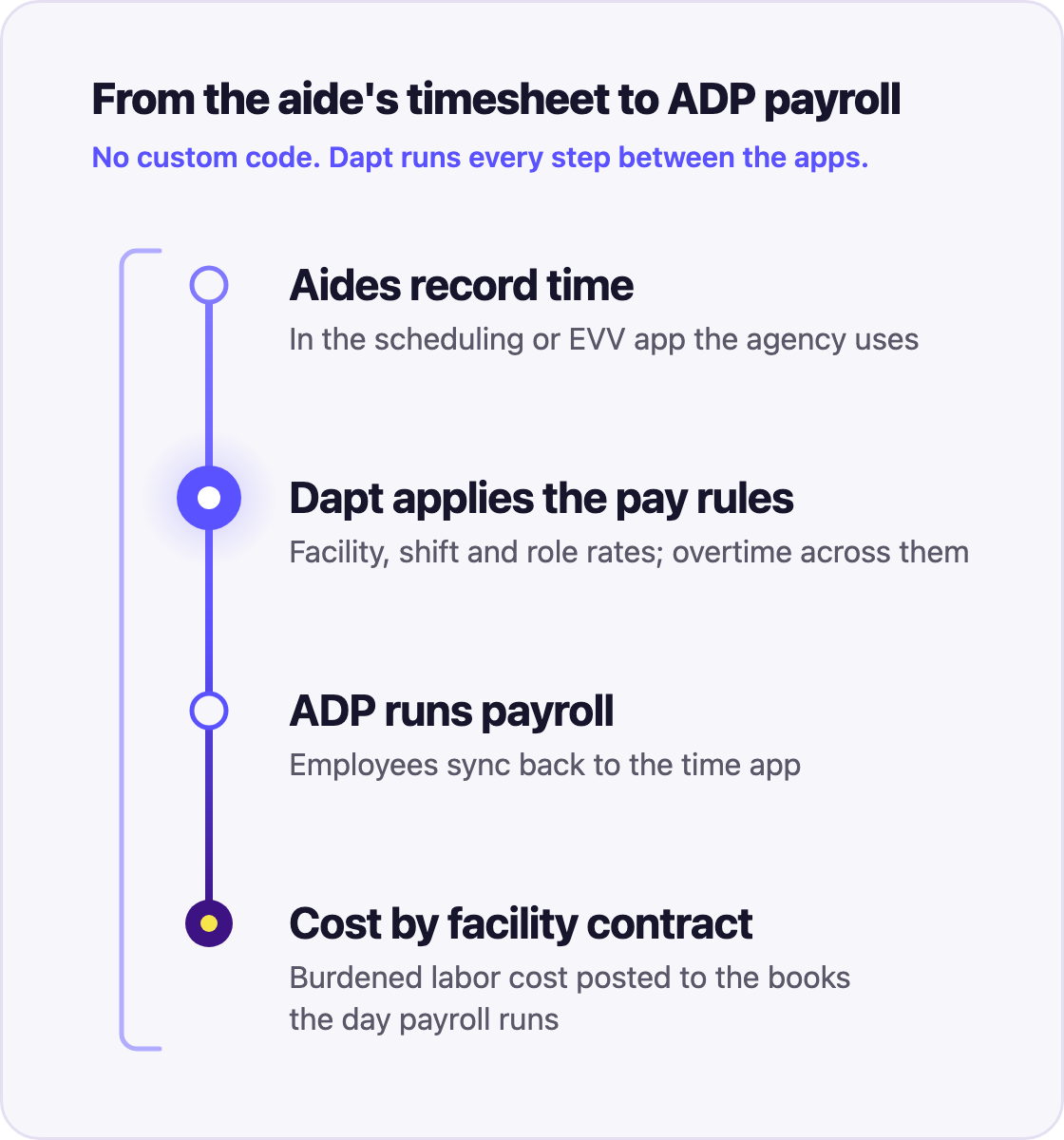
Dapt integrates the systems, keeps the data synchronized between them and automates the process. That removes the manual work, and the errors that come with it. Think of payroll as a flow of information. The aide records what they did and where. The agency’s pay rules determine what those hours are worth. ADP calculates payroll. The payroll results become actual labor cost for accounting. Dapt connects and automates those steps.
1. Read the time that was actually worked
Employees keep recording their time in the system the agency already uses: QuickBooks Time, ClockShark, eBillity, MakeShift or another scheduling, timekeeping or EVV platform. Where an API is available, Dapt uses it. Where one is not, Dapt works with the application’s export data. Nobody has to learn a new app.
2. Apply the agency’s pay rules
Time alone is not enough to run payroll. Suppose Maria works 24 hours at one facility at $22 per hour and 20 hours at a second facility at $25 per hour. Sending 44 hours to payroll does not pay her correctly.
Dapt uses the details on the time record to determine the rate: the facility, the shift, the role or other information in the source system. It then calculates overtime across the different rates an employee worked during the week, and applies the agency’s other rules the same way: shift differentials, guaranteed hours, per-diem payments. The rules live in the payroll process, not inside a custom script.
3. Send the payroll data to ADP
Once the time has been interpreted correctly, the payroll information goes to ADP. The agency still runs payroll in ADP Workforce Now, RUN Powered by ADP or ADP TotalSource. Dapt does not replace ADP; it makes sure ADP receives what it needs.
Employee information also flows from ADP back to the timekeeping system, so a new employee created in ADP is not recreated everywhere else. That closes a common gap: time moving in one direction while the employee and job information needed to record it is maintained by hand in the other.
4. Turn payroll into labor cost
Payroll tells you what employees were paid. Management also needs to know what the work cost.
After payroll, Dapt combines wages with employer payroll taxes, workers’ compensation, benefits and other employer-paid costs to determine the fully burdened labor cost, then posts it to the facility, contract or client where the work occurred in QuickBooks, Sage Intacct, NetSuite or Microsoft Dynamics 365 Business Central. This is job costing for healthcare staffing.
It matters because two contracts with similar revenue can have very different margins. Overtime, higher-paid employees, workers’ compensation and benefits change the economics of a contract quickly. When those costs are visible after every payroll, management can respond while the contract is still active instead of discovering the problem months later.
5. Use the same time for customer billing
An employee may be paid $24 per hour while the facility is billed $38 per hour: two rates on the same work. Dapt uses the recorded time to calculate payroll at the pay rate and generate customer invoices at the billable rate.
Payroll and billing should start from the same source data. When payroll comes from one spreadsheet and billing from another, differences appear and someone has to decide which set of hours is right. One time record for both removes most of that reconciliation.
A healthcare staffing agency runs exactly this for about 50 client facilities. Each facility has its own pay and bill rate per position, a second pair for weekends, its own shift windows, and in three cases its own holiday calendar. Dapt reads the shifts from the agency’s scheduling system, applies the rules, calculates overtime across the rates each aide worked, produces the ADP payroll files for W-2 staff and 1099 contractors, posts the cost to QuickBooks Online and generates every facility’s invoice from the same shifts. When a facility changes a rate, the payroll manager sends the new sheet and it is live for the next payroll.
Custom code or a prebuilt solution?
Both can move data between systems. The difference is who maintains the integration and how easily the business rules can change.
It is rare that custom development makes sense. Evaluate the off-the-shelf options before considering it, even for a requirement that looks unique; connecting timekeeping to ADP is not one. Dapt builds new integrations as standard product, based on what the market asks for. Before commissioning custom software, check whether an existing integration already connects to ADP, and if it does not, ask us whether we will build it as a standard product.
What about scheduling and EVV platforms that already connect to ADP?
Some scheduling, home care and EVV platforms have their own integrations with ADP. If one already handles all of the agency’s payroll requirements, that may be all the agency needs. The question to ask is what the integration actually does. A platform that sends approved hours to ADP has done the first of four jobs.
The scheduling system knows where and when the employee worked. The payroll rules decide how those hours are paid. ADP calculates what the payroll actually cost. Accounting records which facility, client or contract carries that cost.
Dapt works with the scheduling or EVV system the agency already uses and connects the first of those to the other three.
How should a CNA or home care agency choose an ADP timekeeping integration?
Start with the way employees actually get paid rather than with a list of software features.
Do employees work at more than one pay rate?
If an aide can work at different rates in the same week, find out whether the integration transfers the hours or applies the rates, and ask specifically how it handles overtime when multiple rates are involved. That tells you more than asking whether the product “integrates with ADP.”
Where are employees created?
If ADP is the employee system of record, employee information should not be retyped into the timekeeping application. Look at the whole flow, not just the final transfer of hours into payroll.
Can you see labor cost by facility or contract?
Ask one management question: What did a single facility contract cost us in labor last month? If the answer takes payroll reports and a spreadsheet, the agency has automated payroll processing but not labor cost accounting. A useful integration carries the information through payroll and into accounting.
{{banner-small-1="/banners"}}
Do CNA agencies need custom code to integrate timekeeping with ADP?
No. Dapt already integrates with many of the timekeeping systems agencies use: QuickBooks Time, ClockShark, eBillity, MakeShift, JobTread and many others, plus EVV and scheduling platforms by API or export file. The full list is on the integrations page. Taking time recorded by caregivers, applying the agency’s payroll rules and sending the result to ADP is handled by an existing integration, not a custom software project.
The result is not just a faster way to import time into ADP. It is one connected process from the moment an employee records their work through payroll, accounting and customer billing. That is the part custom integrations often miss.
Frequently asked questions
Does DAPT work with the timekeeping system my agency already uses?
Dapt integrates with QuickBooks Time, ClockShark, eBillity, MakeShift and many other timekeeping and EVV systems, through the API where one is available and through export files where it is not. Employees and supervisors stay in the system they already use.
Which ADP platforms does DAPT support?
ADP Workforce Now (current and next generations), RUN Powered by ADP, and ADP TotalSource. Our ADP Marketplace integrations page lists them.
Can DAPT handle different pay rates for different facilities and shifts?
Yes. Pay rules use the facility, shift and employee role to determine which rate applies to the recorded hours. When an employee works at multiple rates in a workweek, Dapt also calculates the overtime across those rates before sending the payroll information to ADP.
Does DAPT only read approved hours?
No. Dapt reads all recorded time, including time that has not yet been approved, and all of it goes into the payroll batch. Supervisor approval stays in the timekeeping system as part of the agency’s workflow; it does not gate payroll.
Do I need a separate job costing system?
No. That is job costing with Dapt: the same connection posts actual labor cost by facility or contract to the accounting system after every payroll. Where an agency has prevailing wage or union work, the same payroll record also produces certified payroll and union reports.
Talk to us
If you are trying to connect a scheduling, timekeeping or EVV system with ADP, we can walk through the whole process with you: how employees record their time, how your pay rules apply, what reaches ADP and what happens with the payroll data afterwards, on the systems you already run.
Contact us to schedule a technology discovery session.